Mobility
Move through useful positions while maintaining control, posture, and stability.
You Are Not Starting From Zero
By our 40s and 50s, many adults begin noticing stiffness, reduced range of motion, changes in balance, and less confidence in everyday movement.
Desk work, long commutes, family responsibilities, old injuries, and years of limited movement can gradually change how the body feels and responds.
At CoVA Karate, we routinely work with adults who have not exercised consistently in years, have never trained in martial arts, or are uncertain about what their body can still do.
We do not start by asking what you used to be able to do.
We start by looking at how you move today.
We observe how you step, turn, shift weight, maintain posture, coordinate the body, and control balance. From there, we adjust the training to the individual.
Movement First
Mobility is not simply being flexible. It is being able to move through a useful range of motion while maintaining control.
Move through useful positions while maintaining control, posture, and stability.
Control your center of gravity while stepping, turning, shifting weight, and changing direction.
Connect the feet, hips, torso, shoulders, breathing, and attention into purposeful movement.
Unlike stretching performed in isolation, Okinawan karate combines range of motion with posture, stepping, rotation, coordination, balance, breathing, timing, and purposeful movement.
You are not simply trying to move farther. You are learning to control the movement you have.
Real Adult Starting Points
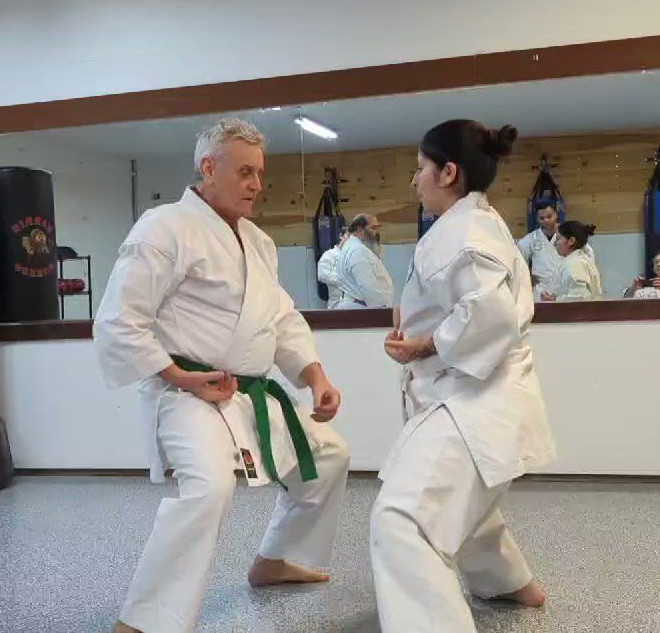
Many new students arrive with tight hips, restricted shoulder movement, limited ankle mobility, years of desk posture, or uncertainty when turning and shifting weight.
Others are worried that they will be expected to keep up with younger athletes.
Can you shift your weight without leaning?
Can you turn while maintaining your balance?
Can your hips and shoulders move without unnecessary tension?
Can you breathe naturally while learning a new movement?
Those observations tell us far more than whether someone can kick high or perform a deep stance.
We may shorten a stance, reduce the range of motion, slow a transition, or separate a movement into smaller parts.
As control improves, movement can become larger, smoother, faster, and more connected.
This is how adult karate becomes progressive rather than punishing.
Karate Is the Method
Our training prioritizes movement quality before unnecessary speed or intensity.
Stances reveal leaning, collapsing knees, unnecessary tension, and loss of structure.
Students learn to move their center of gravity without unnecessarily losing balance or relying on momentum.
Kata connects stepping, turning, posture, breathing, balance, timing, coordination, and controlled transitions.
Controlled partner work adds distance, timing, awareness, positioning, pressure, and adaptation.
Traditional weapons work challenges grip, posture, range, shoulder movement, precision, spatial awareness, and whole-body coordination.
The same movement can be studied repeatedly while posture, balance, breathing, timing, and efficiency gradually improve.
Progress You Can Feel
Progress varies from person to person, but adults commonly tell us they become more aware of how they stand, walk, turn, shift weight, and carry tension.
You do not need to arrive flexible, athletic, coordinated, or already in shape.
The Long View
Do not train only for the body you have today.
A better question for adults in their 40s and 50s is:
What do you want your body to still be capable of doing twenty or thirty years from now?
That is the idea behind Train for 70.
Stances challenge balance and posture. Kata requires stepping, turning, coordination, weight transfer, breathing, and controlled transitions. Partner work introduces timing, distance, pressure, and spatial awareness. Kobudo asks the body to coordinate movement through different ranges and positions.
We are still training karate. We are still studying technique, kata, application, timing, and traditional Okinawan martial arts.
Train now for the body you want to rely on later.
A Different Reason to Train
Many adults assume joining a martial arts school means they need to be interested in fighting, competition, or proving how tough they are.
That is not why many adults come to CoVA Karate.
Move better.
Improve balance.
Develop coordination.
Understand your body.
Learn something difficult.
Keep developing over time.
Practical application and self-defense awareness remain part of karate, but they do not have to be the primary reason you train.
For many adults, karate becomes a long-term study of movement, structure, timing, awareness, and personal development.
What Training Looks Like
Basic stepping and weight transfer develop coordination and balance.
Movement through the ankles, hips, shoulders, and spine is introduced progressively.
Slow stance changes teach movement without leaning or rushing.
Kata links breathing, posture, stepping, turning, timing, and whole-body movement.
Partner exercises introduce distance, timing, positioning, and awareness.
The goal is not to make training easy.
The goal is to make training productive.
More Than Exercise
Okinawan Shorin-ryu develops movement through coordinated, purposeful practice rather than treating mobility as an isolated stretching session.
Students learn to connect the feet, knees, hips, posture, shoulders, breathing, timing, and attention.
Kata gives the student a repeatable framework for studying the same movement again and again.
At first, you learn where the hands and feet go.
Later, the study becomes balance, transitions, muscle tension, breathing, timing, pressure, structure, and how the entire body coordinates movement.
Our mature, low-ego dojo environment allows adults to work seriously without feeling that they must compete with younger athletes or prove what they can still do.
Start Where You Are
You do not need previous martial arts experience or a particular level of fitness before beginning.
Your stance develops with your capability.
Range develops progressively.
You are learning, not racing another student.
During your first classes, we observe how you move, explain the purpose of the material, and make adjustments where appropriate.
If you are beginning martial arts for the first time or returning after years away, visit our Adult Martial Arts for Beginners in Virginia Beach page.
Common Questions
Yes. You are not expected to arrive flexible, athletic, coordinated, or already in shape. Stance depth, speed, range of motion, and repetitions can be adjusted while you develop movement, balance, coordination, mobility, and control.
CoVA Karate emphasizes controlled, progressive movement. Beginners are not expected to perform deep stances, high kicks, or explosive movements beyond their current ability.
No. Age alone does not determine whether someone can begin. What matters is your current movement, balance, experience, goals, and physical capability.
No. New students begin with basic stepping, posture, weight shifting, breathing, and fundamental movement before progressing into more complex kata, partner exercises, practical application, and kobudo.
Okinawan karate provides a structured way to practice posture, balance, weight transfer, rotation, coordination, and controlled range of motion through foundational movement, stances, kata, partner training, and kobudo.
No. Practical application and self-defense awareness are part of karate, but many adults train because they value movement, balance, coordination, body awareness, personal development, and long-term study.
Train for 70 is our reminder to think about long-term capability. Adult training should continue challenging balance, stepping, turning, posture, coordination, weight transfer, body awareness, and controlled movement as we get older.
You experience the regular training environment, meet the instructors and students, and see how the material is introduced from your current starting point before deciding whether CoVA Karate matches your goals.
Your Next Twenty Years Matter
If you are in Virginia Beach and want a martial art that challenges you while placing real value on movement quality, balance, coordination, body awareness, and long-term development, CoVA Karate gives you a structured place to begin.
You do not need to prove that you are athletic enough to start.
You need a starting point and a willingness to learn.
CoVA Karate
Traditional Okinawan karate for adults who want to keep learning, moving, and developing over time.