
For Immediate Release
VIRGINIA BEACH, Va. — CoVA Karate is a member dojo of the National Karate Jujitsu Federation, commonly known as the NKJF.
I do not look at that affiliation as something that replaces what we practice at CoVA Karate. I look at it as an opportunity to remain connected to a larger martial arts community while continuing to develop our own understanding of Okinawan Shorin ryu karate.
There is value in training with people who do not necessarily move the same way, teach the same way or arrive at the same conclusions.
That exposure gives us something to examine, question and test when we return to our own dojo.
Why CoVA Karate Is Part of the NKJF
Every dojo develops its own culture and its own way of approaching training.
CoVA Karate is no different.
Our primary study is Okinawan Shorin ryu. We spend a great deal of time looking at kata, movement, structure, balance, coordination, timing and practical application.
Being part of a larger federation does not require us to stop doing that.
What it does provide is access to instructors and practitioners who may approach similar problems from another direction.
Someone studying jujutsu may look at balance differently. A kobudo practitioner may notice something about distance or body connection. Someone working with escrima may create a different timing problem than we usually see in karate.
I do not believe we have to adopt every idea we encounter.
I do think we should be willing to look at it.
A Federation Should Create Opportunities to Learn
One of the risks in martial arts is becoming too comfortable inside a single system or a single group of people who already agree with one another.
Training outside that environment can be useful because another instructor may ask a different question or solve a familiar problem in a way we have not considered.
Sometimes that reinforces what we are already doing.
Sometimes it makes us reconsider something.
Both are useful.
For me, that is one of the practical purposes of belonging to a federation.
The 2026 Winter Gasshuku
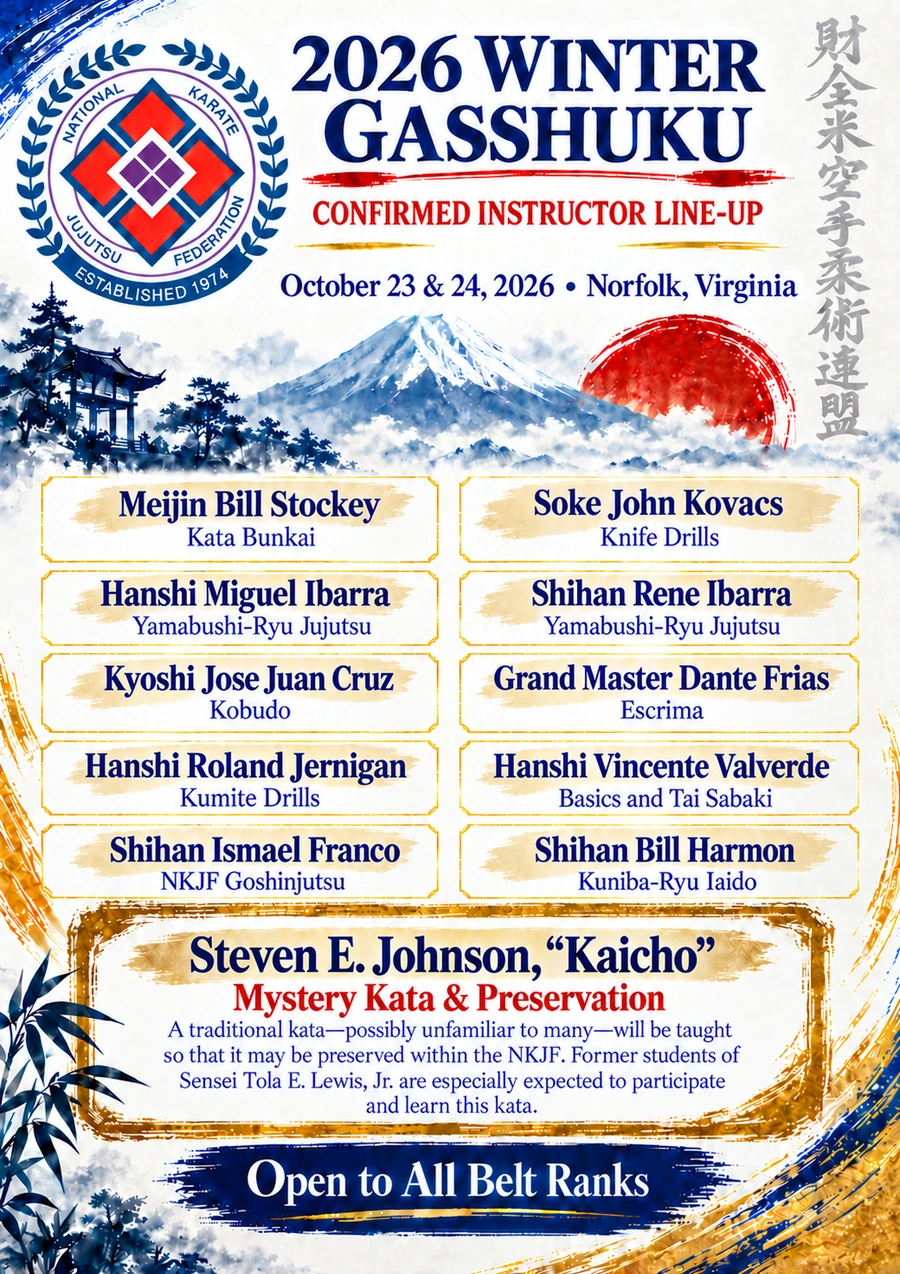
The upcoming NKJF Winter Gasshuku on October 23 and 24, 2026 in Norfolk, Virginia is a good example of what this type of organization can provide.
The event brings together instructors from several martial arts disciplines and gives participants an opportunity to experience different approaches to kata, application, weapons, movement and combative training.
The confirmed instructor line up includes training in kata bunkai, knife drills, jujutsu, kobudo, escrima, kumite drills, tai sabaki, goshinjutsu and iaido.
The Confirmed Instructor Line Up
Meijin Bill Stockey is scheduled to teach kata bunkai, while Soke John Kovacs will present knife drills.
Hanshi Miguel Ibarra and Shihan Rene Ibarra will present Yamabushi Ryu Jujutsu.
Kyoshi Jose Juan Cruz will teach kobudo, and Grand Master Dante Frias will present escrima.
Hanshi Roland Jernigan is scheduled to teach kumite drills. Hanshi Vincente Valverde will work with basics and tai sabaki.
Shihan Ismael Franco will present NKJF Goshinjutsu, while Shihan Bill Harmon will teach Kuniba Ryu Iaido.
The range of subjects is part of what makes an event like this useful. Participants are not limited to seeing one interpretation of martial arts movement or one method of solving a problem.
Mystery Kata and Preservation
Steven E. Johnson, Kaicho, is also scheduled to teach a session called Mystery Kata and Preservation.
According to the event announcement, a traditional kata that may be unfamiliar to many participants will be taught so that it can continue to be preserved within the NKJF.
Former students of Sensei Tola E. Lewis Jr. are especially encouraged to participate and learn the kata.
I find the preservation side of this particularly interesting.
Preserving a kata means more than keeping the sequence alive on paper or video. Someone still has to move it, teach it, question it and pass it from one person to another.
That requires people to train together.
NKJF Winter Gasshuku • October 23 and 24, 2026
Train Together. Share Tradition. Grow Together.
The 2026 National Karate Jujitsu Federation Winter Gasshuku will take place in Norfolk, Virginia and is open to all belt ranks.
What CoVA Karate Students Can Take From This
I do not expect a CoVA Karate student to attend a session in escrima, jujutsu or iaido and suddenly change what they practice.
That is not what I am looking for.
I am interested in what they notice.
How does another instructor create power? How do they control distance? How do they move their weight? How do they maintain structure? How do they enter, turn or recover their balance?
Those observations can come back into our own training without changing the identity of what we do.
They may give us another way to test an idea that we already have.
Keeping an Identity Without Creating an Echo Chamber
I believe a dojo should have a clear identity.
CoVA Karate has one.
We practice Okinawan Shorin ryu and we continue to study the kata, movement and principles that come with that tradition.
Having an identity does not mean every answer has already been found.
I would rather expose our students to experienced martial artists, allow them to see different approaches and then return to the dojo with better questions.
That is different from simply collecting techniques.
The objective is understanding.
Training Beyond the Dojo
Most of our development still happens inside the dojo through regular practice.
Events like the Winter Gasshuku give us an occasional opportunity to step outside that routine and work with people we might not otherwise encounter.
We can train with them, listen to how they explain what they do and experience their movement directly.
Then we return to our own training.
Some ideas will stay with us. Others may not.
That is part of the process.
CoVA Karate and the NKJF
CoVA Karate will continue to maintain its focus on Okinawan Shorin ryu while participating in the larger NKJF community.
I see those two things as complementary.
The dojo gives us a place to go deeply into what we practice.
The federation gives us opportunities to occasionally step outside that environment, train with experienced martial artists from other backgrounds and return with something new to think about.
That is the value I see in the relationship.